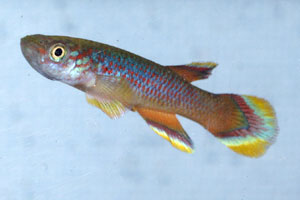
Aphyosemion celiae celiae
Aphyosemion celiae celiae
Aphyosemion celiae celiae
Current Scientific Name:
Aphyosemion celiae celiae
Described: Scheel, 1971
Common name(s):
Some Recorded Strains:
Madimba
Teke CXC 21
Aphyosemion celiae celiae Teke CXC 21
Killi.co.uk is funded by its visitors. When you buy through links on our site we may earn an affiliate commission. For more info see
terms and conditions.
Fort Thomas, Kentucky, 410**, UNITED STATES OF AMERICA
$40
We are hobbyists running a small business breeding & importing different species of aquatic lifeto ship to your aquarium! All of our fish are guaranteed to be correctly identified by species & sex.
The listing is for a male & female pair of Aphyosemion Australe Orange. Killifish are a new passion of ours. They are similar to apistos as all you need to do is throw a pair in a little tank & they??ll be breeding in no time! We are starting to bring ...
more
Mount Morris, Michigan, 484**, UNITED STATES OF AMERICA
$35
Bivittatum Funge Rare Killifish 1 Male Chromaphyosemion
Acclimation:
Breather bags:
do not float place fish in tank immediately. If you float fish will suffocate
Regular bag method:
method for acclimation is to place the unopened bag of fish in your aquarium for about 20 minutes to allow the temps to to rise to your tanks temp. Next, get a clean fish net ready. Place it over a bucket. Dump the contents of the bag into the net. Throw old shipping water out ...
more
Mount Morris, Michigan, 484**, UNITED STATES OF AMERICA
$25
1 Male Orange Australe killifish
Acclimation:
Breather bags:
do not float place fish in tank immediately. If you float fish will suffocate
Regular bag method:
method for acclimation is to place the unopened bag of fish in your aquarium for about 20 minutes to allow the temps to to rise to your tanks temp. Next, get a clean fish net ready. Place it over a bucket. Dump the contents of the bag into the net. Throw old shipping water out and do not place in ...
more Aphyosemion celiae celiae breeding reports
Each record reproduced here represents one instance of breeding this species. Have you kept and bred Aphyosemion celiae celiae? Why not add a breeding report? If you had different results, or used different methods, please share your experiences
How to keep and breed Aphyosemion celiae celiae
This database consists of breeding reports provided by the world killifish community, along with some statistical analysis. Results provided by successful keepers are aggregated in the bar charts below, with more detailed reports below that. Like any block of data, the larger the more significant. Please contribute a report of your attempt to breed Aphyosemion celiae celiae, even if you have had a negative results. You may, of course, file more than one report, particularly if you change some condition, and had a different result.
breeders have filled in breeding reports, a summary of the results are shown in the graphs below.
Would Aphyosemion celiae celiae be a good addition to a community tank?
- Never
- Doubtful, only with VERY calm fish
- Only with species of similar size
- Yes, a good community fish
How would you describe the disposition of Aphyosemion celiae celiae?
- Very timid
- Slightly timid
- Neutral
- Somewhat aggressive on occasions
- Very aggressive
In which water conditions do you keep these fish?
- Very soft and acidic
- Moderately soft and acidic
- Neutral
- Moderately hard and alkaline
- Very hard and alkaline
At what average temperature?
- 10-15°C
- 16-19°C
- 20-23°C
- 24-27°C
- 28°C+
How would you describe sex ratios when breeding Aphyosemion celiae celiae?
- Almost all males
- Somewhat male heavy
- Roughly equal
- Somewhat female heavy
- Almost all females
In general, how difficult is Aphyosemion celiae celiae to keep and breed?
- Very easy
- Easy
- Average
- Difficult
- Very difficult
How successful have you been at breeding Aphyosemion celiae celiae?
- Very unsuccessful
- Fairly unsuccessful
- Average
- Fairly successful
- Very successful
Very successful / fairly successful
Breeding Report: Aphyosemion celiae celiaeWater conditions: Moderately soft and acidic, 20-23oC
Spawning Method: Spawning Mops
Sex ratio: Roughly equal
Breeding difficulty: Easy
Success: Fairly successful
Other Comments: I've found this species to be easy to maintain, and easy to breed.
I breed in teams of four or six fish of equal sexes in 18"x12"x12" tanks. I use a thin layer of peat substrate (only 1/4" or so) and rainwater (pH 5.8 and negligible hardness). Long floating mops are used (black nylon) with the bottom 2-3" trailing on the substrate. Eggs are predominantly laid in these lower strands, but can be found at all levels.
I collect eggs and remove to hatching containers containing water from the breeding tank. A. celiae do not exhibit cannibalistic tendancies, and fry can be raised very successfully with the parent fish. However, I find that growth is quicker, and final adult size is greater if fry are raised in separate tanks.
Eggs are water incubated taking 16 to 21 to hatch at 22 degrees C. The water is kept clean during this period being changed every two days ensuring that eggs are developing and infertile eggs are removed.
Eggs are fairly small but newly hatched fry are relatively large and readily accept Artemia nauplii and microworms as first foods.
Growth rate is medium for Aphyosemions, and sexual maturity is eached in less than 6 months.
I would rate this as an excellent beginners fish, being hardy, relatively active, and easy to breed.
The strain I am keeping has been unusual in that the quality of the fish has improved with each generation I've bred, both in terms of size and colouration.
I plan to maintain this species/strain in the long term and will be happy to provide eggs/young fish to anyone who may be interested in keeping this delightful killi. I will also regularly distribute these fish at the various BKA auctions around the UK.
Breeder: Ian Allcroft BKA 157-06, Harrogate, North Yorkshire (4 years experience with this species)
Date this record created: 14th August 2002
Average success
Breeding Report: Aphyosemion celiae celiaeWater conditions: Neutral, 20-23oC
Spawning Method: Long term (fry appear with adults)
Sex ratio: Roughly equal
Breeding difficulty: Easy
Success: Average
Breeder:
Date this record created: 27th December 2002
Killi.co.uk is funded by its visitors. When you buy through links on our site we may earn an affiliate commission. For more info see
terms and conditions.
Mount Morris, Michigan, 484**, UNITED STATES OF AMERICA
$40
Gold Gardneeri Eggs 10 Count! Lyretail Killifish Aphyosemion
You get 10 eggs shipped in damp coco coir hatch date is 04 / 07 / 24
Shipping:
Fish are fasted for at least 24 hours before being shipped to minimize waste during shipping
DOA Policies:
1. Report DOA within the first 2 hour of received the package. We??re not responsible for any report after 1 hour time frame. The package DOA policy will be voided NO EXCEPTIONS
2. Take a photo of the dead ...
more
Miami, Florida, 331**, UNITED STATES OF AMERICA
$40
Important Shipping Information from Source Aquatics At Source Aquatics, we prioritize the safe transport of your Aphyosemion australe. Here are our shipping guidelines:
? Shipments are conducted on Mondays, Tuesdays, and Wednesdays via FEDEX & UPS. ? DOA Guarantee is applicable to next-day shipping, refunds less shipping costs. ?️ Temperature-appropriate packaging is used based on destination climate (local temperature info is helpful). ? ...
more
Indianapolis, Indiana, 462**, UNITED STATES OF AMERICA
$66
* For the safety of our animals, we now ship live fish exclusively via UPS Next Day Air If your order contains this item, you will only see UPS Next Day Air as a shipping option during checkout *
The Red Cap Medaka Ricefish is an extremely rare and lovely variant of its species!
The Red Cap Medaka Ricefish (Oryzias latipes ??Red Cap??), also known as the Japanese Ricefish or Japanese Killifish, is an extraordinarily adaptable fish species. This schooling fish can be the ...
more
Orlando, Florida, 328**, UNITED STATES OF AMERICA
$16
You will receive 3 healthy fish (1male / 2 females) plus 1 additional free least killifsh. Heterandria formosa (Least killifish) aka the smallest livebearer in the world are a hardy native fish found in Florida and select areas of the south eastern united states. Females can get just over an inch and are slightly more round than their smaller and more slender male counterparts. They can withstand cooler temperatures and can be kept without a heater at room temperature. Peaceful fish that ...
more
Ardenvoir, Washington, 988**, UNITED STATES OF AMERICA
$13
Grindal worms are small cousins to earthworms, and appeal to many species of fish, and fish fry, and are very easy to raise! You will receive a 2 oz portion cup of soil less media filled with live grindal worms, as well as detailed instructions to get your colony going and reproducing quickly. Also check out our other live fish food items, as well as heirloom seeds for the gardener in you!...
more
San Jose, California, 951**, UNITED STATES OF AMERICA
$23
The unisex heavy cotton tee is the basic staple of any wardrobe. It is the foundation upon which casual fashion grows. All it needs is a personalized design to elevate things to profitability. The specialty spun fibers provide a smooth surface for premium printing vividity and sharpness. No side seams mean there are no itchy interruptions under the arms. The shoulders have tape for improved durability.
: 100% Cotton (fiber content may vary for different colors)
: Medium fabric (5 3 ...
more






.jpg)
.jpg)