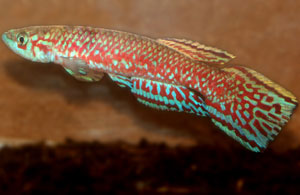
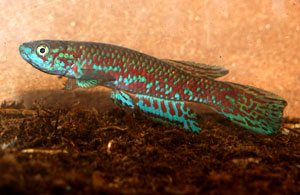
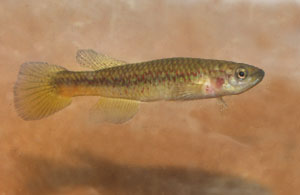
Scriptaphyosemion cauveti Kindia
Scriptaphyosemion cauveti Kindia
Scriptaphyosemion cauveti Kindia Female
Current Scientific Name:
Scriptaphyosemion cauveti
Described: Romand & Ozouf-Costaz, 1995
Common name(s):
Some Recorded Strains:
CI 6-93
GRCH 93/293, Barraque de Loire d'Atlantique
Kindia
Siramousaya
Siramousaya GRCH 93-238
Breeding Scriptaphyosemion cauveti
Have you had any experience breeding this species? Why not fill in a species questionaire
5 other fishkeepers have successfully bred this species and left reports, their results are sumarised below
Method:
Spawning Mops (50%)
Long term (fry appear with adults) (50%)Water Conditions:
Neutral (25%)
Moderately soft and acidic (25%)
Very soft and acidic (25%)
Moderately hard and alkaline (25%)Temperature:
20-23°C (75%)
24-27°C (25%)
Read the full breeding report(s) for Scriptaphyosemion cauveti
Killi.co.uk is funded by its visitors. When you buy through links on our site we may earn an affiliate commission. For more info see
terms and conditions.
Birch Run, Michigan, 484**, UNITED STATES OF AMERICA
$40
15-25 Eggs expect 4-7 day's for orders to be collected
?? Live Arrival GuaranteeWe guarantee all fish will arrive alive and healthy. If you receive a DOA (Dead on Arrival):Contact us within 2 hours of delivery Provide clear photos of the fish inside the sealed bag We??ll evaluate the case and may offer a replacement or partial refund, depending on the situation Note: Guarantee void if no one is present at first delivery attempt ?️ Weather & Shipping RestrictionsShipments may be ...
more
Indianapolis, Indiana, 462**, UNITED STATES OF AMERICA
$12
* For the safety of our animals, we now ship live fish exclusively via UPS Next Day Air If your order contains this item, you will only see UPS Next Day Air as a shipping option during checkout *
This small fish is very peaceful and ideal for both beginners and experts alike, plus it is an excellent addition to the planted aquarium!
The Norman??s Lampeye Killifish (Poropanchax normani) is a peaceful fish whose small size makes it absolutely perfect for the nano or planted ...
more
Indianapolis, Indiana, 462**, UNITED STATES OF AMERICA
$66
* For the safety of our animals, we now ship live fish exclusively via UPS Next Day Air If your order contains this item, you will only see UPS Next Day Air as a shipping option during checkout *
The Red Cap Medaka Ricefish is an extremely rare and lovely variant of its species!
The Red Cap Medaka Ricefish (Oryzias latipes ??Red Cap??), also known as the Japanese Ricefish or Japanese Killifish, is an extraordinarily adaptable fish species. This schooling fish can be the ...
more Scriptaphyosemion cauveti breeding reports
Each record reproduced here represents one instance of breeding this species. Have you kept and bred Scriptaphyosemion cauveti? Why not add a breeding report? If you had different results, or used different methods, please share your experiences
How to keep and breed Scriptaphyosemion cauveti
This database consists of breeding reports provided by the world killifish community, along with some statistical analysis. Results provided by successful keepers are aggregated in the bar charts below, with more detailed reports below that. Like any block of data, the larger the more significant. Please contribute a report of your attempt to breed Scriptaphyosemion cauveti, even if you have had a negative results. You may, of course, file more than one report, particularly if you change some condition, and had a different result.
breeders have filled in breeding reports, a summary of the results are shown in the graphs below.
Would Scriptaphyosemion cauveti be a good addition to a community tank?
- Never
- Doubtful, only with VERY calm fish
- Only with species of similar size
- Yes, a good community fish
How would you describe the disposition of Scriptaphyosemion cauveti?
- Very timid
- Slightly timid
- Neutral
- Somewhat aggressive on occasions
- Very aggressive
In which water conditions do you keep these fish?
- Very soft and acidic
- Moderately soft and acidic
- Neutral
- Moderately hard and alkaline
- Very hard and alkaline
At what average temperature?
- 10-15°C
- 16-19°C
- 20-23°C
- 24-27°C
- 28°C+
What, if any is the biggest difficulty encountered when breeding these fish?
- Poor egg production
- Poor egg survival
- Poor fry survival rate
- Deformities
- Skewed sex ratio
How would you describe sex ratios when breeding Scriptaphyosemion cauveti?
- Almost all males
- Somewhat male heavy
- Roughly equal
- Somewhat female heavy
- Almost all females
In general, how difficult is Scriptaphyosemion cauveti to keep and breed?
- Very easy
- Easy
- Average
- Difficult
- Very difficult
How successful have you been at breeding Scriptaphyosemion cauveti?
- Very unsuccessful
- Fairly unsuccessful
- Average
- Fairly successful
- Very successful
Very successful / fairly successful
Breeding Report: Scriptaphyosemion cauvetiWater conditions: Moderately soft and acidic, 20-23oC
Spawning Method: Spawning Mops
Sex ratio: Roughly equal
Breeding difficulty: Very easy
Success: Very successful
Breeder: Rickard Berg 671-10, Sweden/Västerbotten (5 years experience with this species)
Date this record created: 3rd December 2002
Breeding Report: Scriptaphyosemion cauvetiLocation code: GRCH 93/293, Barraque de Loire d'Atlantique
Water conditions: Very soft and acidic, 20-23oC
Spawning Method: Long term (fry appear with adults)
Breeding problems: Poor fry survival rate
Sex ratio: Somewhat male heavy
Breeding difficulty: Very easy
Success: Very successful
Other Comments: Very beautiful fish with high intense colors of dark blue mixed with deep red. Can be breed with mop or in a larger group setup. Usually fry come up in moderate quantities together with the adults. I have them in a heavily planted large community tank (400 litres) with few other fishes. They perform well even at longer periods of higher temperatures (27°C and above). Fry come up also in this tank. For intensive breeding, the mop method in a small (10 litre) tank is preferred.
Breeder: Axel Schwekendiek, Germany
Date this record created: 5th October 2003
Breeding Report: Scriptaphyosemion cauvetiLocation code: Kindia
Water conditions: Moderately hard and alkaline, 24-27oC
Spawning Method: Long term (fry appear with adults)
Breeding difficulty: Very easy
Success: Very successful
Other Comments: I left 3 pairs in a 30g tank. Chock full of najas, and a few mops. A 3mm layer of sand as a substrate. After 3 months it is full of fish from small fry to 1 inch juvenilles. Interestingly enough the adults are VERY timid. I never see them. Not ever. The young are a different story; they seem quite at home, spending their lives playing by the front glass
Breeder: Jules (2 years experience with this species)
Date this record created: 8th March 2004
Breeding Report: Scriptaphyosemion cauvetiWater conditions: Neutral, 20-23oC
Spawning Method: Spawning Mops
Breeding problems: Skewed sex ratio
Sex ratio: Somewhat male heavy
Breeding difficulty: Average
Success: Fairly successful
Other Comments: Initial experience with these fishes was that they were very timid. They would hide away in plants/mops and never been seen except for a lightning dash to snatch food. However, I've found that by keeping them in tanks with with other species (and only by using other species) they will become much calmer and willing to show themselves.
Breeding is no problem - they are reasonably prolific when well settled, and will spawn on bottom-mops and in substrate (peat fibre).
I remove eggs from mops and fry fromthe parent tank as I have seen small fry taken on occasion.
Eggs are small, but fry represent no particular problems and will immediately accept Artemia nauplii on hatching. Growth rate is average.
I keep my fish in a tapwater/rainwater mix 50/50 which is pH 6.5 and dH4. Temperature is 22C, but I've foundno change in behaviour or egg production in temperatures ranging from 18C to 26C.
Breeder: Ian Allcroft BKA 157-06, Harrogate, North Yorkshire (3 years experience with this species)
Date this record created: 14th August 2002
Average success
Breeding Report: Scriptaphyosemion cauvetiWater conditions: Neutral, 20-23oC
Spawning Method: Spawning Mops
Breeding problems: Skewed sex ratio
Sex ratio: Somewhat male heavy
Breeding difficulty: Average
Success: Average
Other Comments: As per my entry for the Kindia location for this species. No real differences other than I find that the Kindia location has stronger colouration and demarkation on the flanks.
Breeder: Ian Allcroft BKA 157-06, Harrogate, North Yorkshire (2 years experience with this species)
Date this record created: 14th August 2002
Breeding Report: Scriptaphyosemion cauvetiLocation code: Kindia
Water conditions: Moderately soft and acidic, 20-23oC
Spawning Method: Long term (fry appear with adults)
Breeding problems: Poor egg production
Sex ratio: Roughly equal
Breeding difficulty: Easy
Success: Average
Other Comments: The fish are very easy to keep and will readily accept frozen foods and live. Live BBS and blackworms will cause the female to roe up quickly. The eggs are tiny, my pair hides them and the fry just show up in the tank. Fry are small and will need infusoria for about a week or so before graduating to microworms and live bbs.
Breeder: Michael McCarthy, Columbus, OH, USA (1 years experience with this species)
Date this record created: 13th May 2004
Breeding Report: Scriptaphyosemion cauvetiLocation code: GRCH 93/293, Barraque de Loire d'Atlantique
Water conditions: Moderately soft and acidic, 20-23oC
Spawning Method: Spawning Mops
Sex ratio: Somewhat female heavy
Breeding difficulty: Average
Success: Average
Other Comments: The accurate location code of this population is Barrage de la Loire Atlantique GRCH 93 / 239 insted of "GRCH 93/293, Barraque de Loire d'Atlantique". There is a good explanation of the errors maid by the names and codes of this species populations on this link:http://www.killifish.f9.co.uk/Killifish/Killifish%20Website/Ref_Library/Scriptaphyosemion/S.cauveti.htm
Breeder: Peter M?čada, Slovakia (2 years experience with this species)
Date this record created: 5th September 2005
Unsuccessful
Breeding Report: Scriptaphyosemion cauvetiWater conditions: Neutral, 20-23oC
Spawning Method: Long term (fry appear with adults)
Sex ratio: Roughly equal
Breeding difficulty: Easy
Success: Fairly unsuccessful
Other Comments: Fry are generally left alone by parents, however, older fry will feed on younger newly hatched siblings.Removing them to a separate container will improve survival rates, they grow slowly.
Live food such as microworms and BBS are eagerly accepted, they can easily be converted to quality dried foods as well.
Bottom mops seem to be preferred for laying eggs as well as hiding. A darkened area for the tank is also recommended.
Breeder: Kent Carpenter, Rochester, NY
Date this record created: 15th March 2003
Killi.co.uk is funded by its visitors. When you buy through links on our site we may earn an affiliate commission. For more info see
terms and conditions.
Indianapolis, Indiana, 462**, UNITED STATES OF AMERICA
$18
* For the safety of our animals, we now ship live fish exclusively via UPS Next Day Air If your order contains this item, you will only see UPS Next Day Air as a shipping option during checkout *
This fairly uncommon lampeye killifish is a real standout due to its iridescent blue-green horizontal striping!
The Neon Stripe Lampeye Killifish (Aplocheilichthys macrophthalmus) is a peaceful fish whose small size makes it absolutely perfect for the nano or planted aquarium. Its ...
more
San Jose, California, 951**, UNITED STATES OF AMERICA
$23
The unisex heavy cotton tee is the basic staple of any wardrobe. It is the foundation upon which casual fashion grows. All it needs is a personalized design to elevate things to profitability. The specialty spun fibers provide a smooth surface for premium printing vividity and sharpness. No side seams mean there are no itchy interruptions under the arms. The shoulders have tape for improved durability.
: 100% Cotton (fiber content may vary for different colors)
: Medium fabric (5 3 ...
more
Indianapolis, Indiana, 462**, UNITED STATES OF AMERICA
$15
* For the safety of our animals, we now ship live fish exclusively via UPS Next Day Air If your order contains this item, you will only see UPS Next Day Air as a shipping option during checkout *
This hardy, robust killifish is an extremely colorful, excellent specimen for the planted aquarium!
The Blue Gardner's Killifish (Fundulopanchax gardneri) is an extremely colorful, peaceful fish whose small size makes it absolutely perfect for the nano or planted aquarium. Native ...
more
Indianapolis, Indiana, 462**, UNITED STATES OF AMERICA
$18
* For the safety of our animals, we now ship live fish exclusively via UPS Next Day Air If your order contains this item, you will only see UPS Next Day Air as a shipping option during checkout *
The American Flagfish, also known as the Florida Flagfish, is a hardy community fish that is one of the few species that eats black beard algae! It is also great for small ponds!
The American Flagfish Killifish (Jordanella floridae) is a colorful, peaceful fish that is native to much of ...
more
Ardenvoir, Washington, 988**, UNITED STATES OF AMERICA
$4
Walter worms are a great first food for your newborn bettas, killifish, gouramis, and many more. These guys are smaller than microworms, but larger than banana worms. Feeding live feeds such as Walter worms will stimulate your newborn fry's instinct to hunt, as well as offering prime nutrition for y our babies. This is a small culture, but fret not, they reach sexual maturity at about 3 days, and from that moment on produce anywhere beween 20 and 40 babies a day, so populations explode VERY ...
more
Lakewood, California, 907**, UNITED STATES OF AMERICA
$9
Welcome to Another Nautilus Tropical Fish Auction!
Introducing the Rocket Killifish ?? A Colorful and Active Nano Fish
The Rocket Killifish (Epiplatys annulatus), also known as the Clown Killifish, is a stunning and peaceful nano fish perfect for small aquariums. With its vibrant red and blue stripes and rocket-like tail pattern, this species is an eye-catching addition to any tank. These surface-dwelling fish are easy to care for and thrive in planted aquariums
FISH ...
more