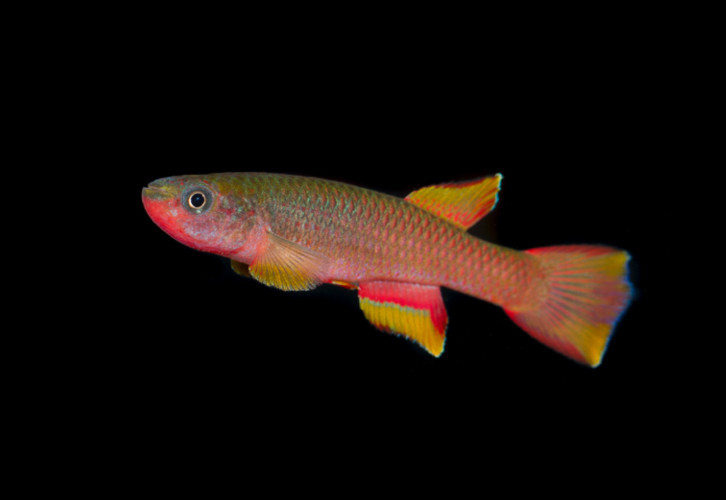
Current Scientific Name:
Aphyosemion lugens
Described: Amiet, 1991
Common name(s):
Some Recorded Strains:
Afan Essokie HLM 99-28
Breeding Aphyosemion lugens
Have you had any experience breeding this species? Why not fill in a species questionaireKilli.co.uk is funded by its visitors. When you buy through links on our site we may earn an affiliate commission. For more info see
terms and conditions.
Birch Run, Michigan, 484**, UNITED STATES OF AMERICA
$40
15-25 Eggs expect 4-7 day's for orders to be collected
?? Live Arrival GuaranteeWe guarantee all fish will arrive alive and healthy. If you receive a DOA (Dead on Arrival):Contact us within 2 hours of delivery Provide clear photos of the fish inside the sealed bag We??ll evaluate the case and may offer a replacement or partial refund, depending on the situation Note: Guarantee void if no one is present at first delivery attempt ?️ Weather & Shipping RestrictionsShipments may be ...
more
Birch Run, Michigan, 484**, UNITED STATES OF AMERICA
$40
15-25 Eggs expect 4-7 day's for orders to be collected
?? Live Arrival GuaranteeWe guarantee all fish will arrive alive and healthy. If you receive a DOA (Dead on Arrival):Contact us within 2 hours of delivery Provide clear photos of the fish inside the sealed bag We??ll evaluate the case and may offer a replacement or partial refund, depending on the situation Note: Guarantee void if no one is present at first delivery attempt ?️ Weather & Shipping RestrictionsShipments may be ...
more
Birch Run, Michigan, 484**, UNITED STATES OF AMERICA
$40
15-25 Eggs expect 4-7 day's for orders to be collected
?? Live Arrival GuaranteeWe guarantee all fish will arrive alive and healthy. If you receive a DOA (Dead on Arrival):Contact us within 2 hours of delivery Provide clear photos of the fish inside the sealed bag We??ll evaluate the case and may offer a replacement or partial refund, depending on the situation Note: Guarantee void if no one is present at first delivery attempt ?️ Weather & Shipping RestrictionsShipments may be ...
more Aphyosemion lugens breeding reports
Each record reproduced here represents one instance of breeding this species. Have you kept and bred Aphyosemion lugens? Why not add a breeding report? If you had different results, or used different methods, please share your experiences
How to keep and breed Aphyosemion lugens
This database consists of breeding reports provided by the world killifish community, along with some statistical analysis. Results provided by successful keepers are aggregated in the bar charts below, with more detailed reports below that. Like any block of data, the larger the more significant. Please contribute a report of your attempt to breed Aphyosemion lugens, even if you have had a negative results. You may, of course, file more than one report, particularly if you change some condition, and had a different result.
breeder has filled in a breeding report, a summary of which is shown in the graphs below.
Average success
Breeding Report: Aphyosemion lugensLocation code: Afan Essokie HLM 99-28
Water conditions: Moderately soft and acidic, 20-23oC
Spawning Method: Peat (or similar) spawning substrate
Sex ratio: Somewhat male heavy
Breeding difficulty: Average
Success: Average
Other Comments: For breeding I used an aquarium of 20x20x30 cm. It is tight covered and equipped with an internal filter. The water should have about 200 to 300 ìS (not more than 6° DGH) pH 6,5 and water temperature approximately 22 to 24°C. In case the tap water has higher values one can mix it with soft water like this from an osmose apparatus. Working with fiber peat moss is recommended and if using soft water the pH value will decrease. It is possible to work also with a top mop. But using fiber peat I had better success. Before breeding the females were kept separately and fed with heavy food. The breeding set exists of one male and two females.
The fish will be brought into an optimal spawning mood with a result of water change of 1/3 and changing the fiber moss. So the pH- value will be lowered. After an other week a 1/3 of the water should be changed. It does not matter if the peat moss whirls up. A further week later the breeding pair and 2/3 of the water I remove from this aquarium. This water can be used for a new breeding set. The rest of the water and the peat moss with the eggs will be given into a dish. Then I pourr 2 liter soft water of approximately 100 ìs to the peat with the eggs. Several days later you can see the small fishes on the surface of the water. They will fed with vinegar eels and new hatched Artemia nauplii immediately. Dead food must be removed daily and a mouldy skin on the water surface, too. After 3 weeks it is recommended to pousr the fish with the water into a bigger aquarium. To prevent Oodinium it is useful to add tap water in the course of a week in small portions into this aquarium.
Feeding sifted Cyclops nauplii and regularly changing of water is necessary for good growth. When the youngster are large enough one can install an interior filter.
Breeder: Rudolf Pohlmann, DKG-study group Chromaphyosemion
Date this record created: 12th August 2003
Killi.co.uk is funded by its visitors. When you buy through links on our site we may earn an affiliate commission. For more info see
terms and conditions.
Birch Run, Michigan, 484**, UNITED STATES OF AMERICA
$40
15-25 Eggs expect 4-7 day's for orders to be collected
?? Live Arrival GuaranteeWe guarantee all fish will arrive alive and healthy. If you receive a DOA (Dead on Arrival):Contact us within 2 hours of delivery Provide clear photos of the fish inside the sealed bag We??ll evaluate the case and may offer a replacement or partial refund, depending on the situation Note: Guarantee void if no one is present at first delivery attempt ?️ Weather & Shipping RestrictionsShipments may be ...
more
Birch Run, Michigan, 484**, UNITED STATES OF AMERICA
$40
15-25 Eggs expect 4-7 day's for orders to be collected
?? Live Arrival GuaranteeWe guarantee all fish will arrive alive and healthy. If you receive a DOA (Dead on Arrival):Contact us within 2 hours of delivery Provide clear photos of the fish inside the sealed bag We??ll evaluate the case and may offer a replacement or partial refund, depending on the situation Note: Guarantee void if no one is present at first delivery attempt ?️ Weather & Shipping RestrictionsShipments may be ...
more
Birch Run, Michigan, 484**, UNITED STATES OF AMERICA
$40
15-25 Eggs expect 4-7 day's for orders to be collected
?? Live Arrival GuaranteeWe guarantee all fish will arrive alive and healthy. If you receive a DOA (Dead on Arrival):Contact us within 2 hours of delivery Provide clear photos of the fish inside the sealed bag We??ll evaluate the case and may offer a replacement or partial refund, depending on the situation Note: Guarantee void if no one is present at first delivery attempt ?️ Weather & Shipping RestrictionsShipments may be ...
more
Birch Run, Michigan, 484**, UNITED STATES OF AMERICA
$30
15-25 Eggs expect 4-7 day's for orders to be collected
?? Live Arrival GuaranteeWe guarantee all fish will arrive alive and healthy. If you receive a DOA (Dead on Arrival):Contact us within 2 hours of delivery Provide clear photos of the fish inside the sealed bag We??ll evaluate the case and may offer a replacement or partial refund, depending on the situation Note: Guarantee void if no one is present at first delivery attempt ?️ Weather & Shipping RestrictionsShipments may be ...
more
Birch Run, Michigan, 484**, UNITED STATES OF AMERICA
$120
Breeding Pair
?? Live Arrival GuaranteeWe guarantee all fish will arrive alive and healthy. If you receive a DOA (Dead on Arrival):Contact us within 2 hours of delivery Provide clear photos of the fish inside the sealed bag We??ll evaluate the case and may offer a replacement or partial refund, depending on the situation Note: Guarantee void if no one is present at first delivery attempt ?️ Weather & Shipping RestrictionsShipments may be postponed during extreme temperatures ...
more
Birch Run, Michigan, 484**, UNITED STATES OF AMERICA
$40
15-25 Eggs expect 4-7 day's for orders to be collected
?? Live Arrival GuaranteeWe guarantee all fish will arrive alive and healthy. If you receive a DOA (Dead on Arrival):Contact us within 2 hours of delivery Provide clear photos of the fish inside the sealed bag We??ll evaluate the case and may offer a replacement or partial refund, depending on the situation Note: Guarantee void if no one is present at first delivery attempt ?️ Weather & Shipping RestrictionsShipments may be ...
more