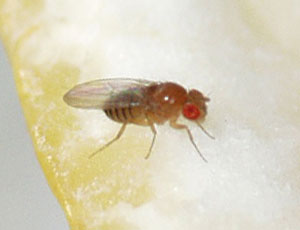
Fruit flies are an excellent food for many surface feeding killifish, closely resembling their natural diets in the wild. They are easy to culture, quickly, cheaply and in large numbers. Fruit flys are rarely available in pet shops, but are widely available online, and very much worth trying, even if you don't bother culturing them on an ongoing basis.
What is a fruit fly?
Fruit flies are small flies that live on and around decaying fruit and vegetation. They occur worldwide, except the very coldest regions. The species most familiar to scientists, aquarists and herpetologists are in the genus Drosophila which literally means 'dew-lover' in Greek. Also known as 'bar fly' or 'vinegar fly', these little flies are commonly found around waste bins, bars, orchards etc, and they are widely used in laboratories as research animals. The species we feed to our fish however, have been bred to have shorter 'vestigial' wings, and as such can not fly. These are typically from two species Drosophila melanogaster and Drosophila Hydei.
Why fruit flies?
Although dealing with highly mobile flies can be trickier than with worms, there are some great reasons to consider culturing them.
- Nutritious - all fish can be trained to eat flies, but surface feeders love them. Not only are they relished by the fish, but they also have a high fibre content, and are therefore a great contrast to the fattier foods such as worms and beef heart. They are also typically disease-free, unlike some aquatic livefoods.
- Prolific An adult fly can lay 20+ eggs in a day. Once you get the hang of it, fruit flies are easy to maintain, and at 25 deg. centigrade the development of Drosophila melanogaster takes just 9 days.
- Availability - unlike collected livefoods, cultured Drosophila are available all year round.
- Flightless flies available - fruit flies have been studied in laboratories for very many years, and a lot is known about the humble fruit fly. Over the course of these studies, geneticists line-bred many strains of fly, including vestigial-winged, and even wingless flies. These are the flies typically cultured by hobbiests.
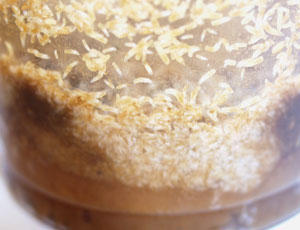
Drosophila larvae in a typical culture
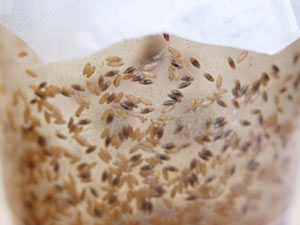
Drosophila larvae climb up the walls of their vials and chrysalise
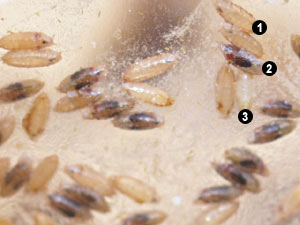
Drosophila pupae
Drosophila life cycle
Adult flies lay a lot of eggs. A single female can lay over 20 eggs in a day, and can store sperm within her body for up to two weeks, to lay fertilized eggs at will.
Eggs take 23 hours to hatch at 25 deg C. Once they do hatch, the larvae bury into the media and grow. They will stay as larvae for five days, in which time they undergo three moults.
Eventually they will start to climb the sides of the vial, and when fully grown will settle near the top, and form a chrysalis. The change from maggot to fly takes around three days, but again, is temperature dependent.
The image to the right shows a newly formed chrysalis with the lava's segments still visible (1), an older chrysalis with the fly clearly visible. The red dots are its eyes (2) and an empty chrysalis from which a fly will have hatched (3).
Once the flies have emerged they must be moved to new vials, as there is now no food suitable for them in the old vials.
Fruit fly cultures for sale
Killi.co.uk is funded by its visitors. When you buy through links on our site we may earn an affiliate commission. For more info see
terms and conditions.
Cleveland, Georgia, 305**, UNITED STATES OF AMERICA
$40
??PLEASE READ BEFORE PURCHASING??
(WHAT YOU RECEIVE)
-------------------------------------------------------------------------------------
Name: "Golden" Drosophila hydei Fruit Flies
Sizes: Flies, Larva & Eggs
Count: 50+ (will produce prolifically)
Sex: M / F
WITH EXTREME TEMPS THERE WILL ONLY BE
LIVE ARRIVAL GUARANTEE WHEN UPGRADE TO
PRIORITY MAIL OR IN TEMPS BETWEEN 0 - 85F
COOL PACKS WILL BE ADDED IF NEEDED
(CULTURE ...
view on ebay
Millsboro, Delaware, 199**, UNITED STATES OF AMERICA
$35
Josh's Frogs Fruit Fly Media - Hydei Formula, 1 5lbs. Condition is New. Shipped with Standard Shipping....
view on ebay
Phoenix, AZ, UNITED STATES OF AMERICA
$32
eBay Product Listing Welcome to shopping excellence
Browse with confidence, leave with satisfaction
32oz Deli Cups with Fabric Vented Lids, Fruit Fly Culture Cups and Fabric Lined Lids, Fruit Flies Feeder Culture Containers Prevent Escapes - 10 Pack
Image Gallery
Product Description
【Escape-Proof Ventilation System】Our deli cup with fabric vented lids feature a breathable fabric cover made with precision-woven breathable fabric. This fabric lined lid prevents liquid ...
view on ebay
Dover, Pennsylvania, 173**, UNITED STATES OF AMERICA
$35
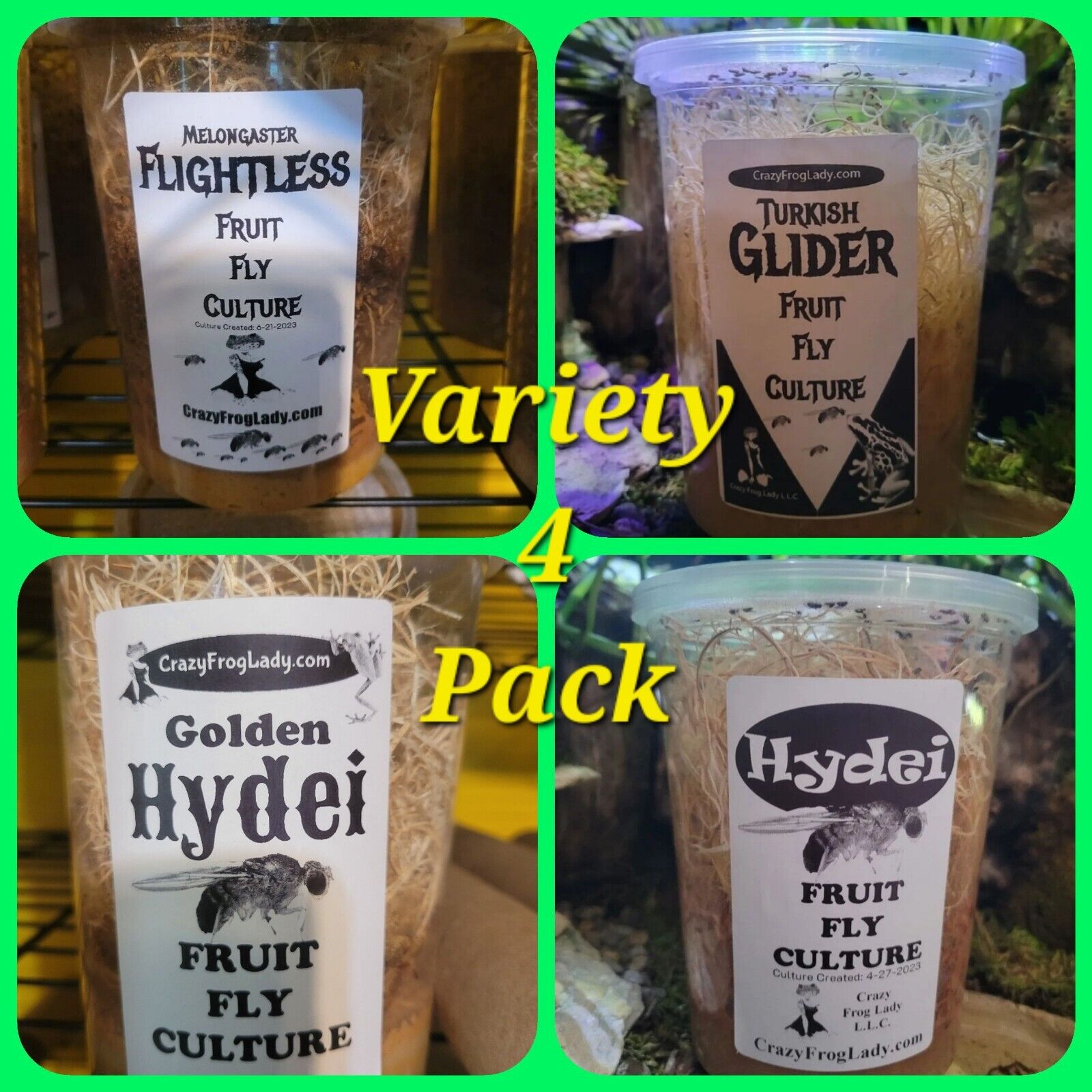
This Fruit Fly Culture 4Pack Variety is the perfect food for your pet reptiles. You'll receive live flightless fruit flies of different species, including Turkish Gliders, Golden, and Hydei. These fruit flies are bred by Crazy Frog Lady L L.C , a trusted brand in the pet supplies industry.
Use this variety pack to provide nutrition to your reptiles and keep them healthy. These live fruit flies are a great source of protein and are easy to digest. They also provide entertainment for your pets...
view on ebay
Dover, Pennsylvania, 173**, UNITED STATES OF AMERICA
$57
6 pack Melongaster Wingless Fruit Flies
Live fruit flies are a great option for feeding small lizards and many species of frogs, especially because of their reproduction cycle. Each culture of flightless fruit flies has a lifespan of about one month, and even after they die, they will continually pupate from eggs laid by the adults in the culture! This will allow you to keep fruit flies for a while, as long as they are taken care of accurately
Regular fruit flies should be ...
view on ebay