Killifish

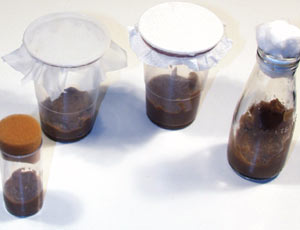
Typical Drosophila vials

Housing

Flies are typically kept in plastic or glass containers. I strongly recommend polypropylene plastic vials. Glass containers seem to suffer from condensation to a much greater extent. This can prevent the media from adhering to the vial (allowing it to slip when the vial is inverted), and prevent flies from climbing up the side of the vial.

Re-useability is something that we should all aim for, however fruit fly vials get SO 'glued-on' that it is often very messy and time consuming to clean them effectively, and fly keepers often use disposable cups. However, polypropylene plastic vials with straight sides really are the best choice. The media stays in place better, and if soaked and washed with a bottle brush, can be cleaned and reused easily. Conical flasks are just that bit harder to clean. Such containers are somewhat hard to source, but are available from scientific suppliers online.

Vials can be sealed with sponge (you can make your own - though they are somewhat difficult to cut perfectly; but again available online from scientific suppliers), these are good at keeping out mites, and very convenient. Less good options include: cotton wool (cheap, easy, but only good for vials with small openings. Not reuseable.), filter paper (can be damaged when wet) or netting (cheap, reuseable, can allow mites and interbreeding with wild flies). If you use netting, it is best to keep the flies in a cabinet to keep out other flies.
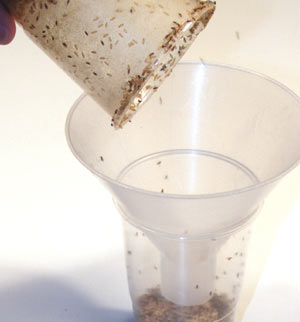
A funnel is critical when transferring flies

Handling fruit flies?

Under laboratory conditions flies need to be moved from container to container without any escape. This is performed by anaesthetising the flies with CO2 or ether. This renders them unconscious for a minute or two without damage. Even fully flighted flies can be easily managed in this way. If you have a cylinder of CO2 handy, perhaps for a planted aquarium, try inverting the vial, and introducing a gentle flow of CO2 by inserting a fine tube past the sponge topper. After just a few seconds the flies will fall unconscious. This is where the consistency of the media is essential. If your flies are kept over sloppy media, when it is inverted, media will slide down the side of the container, sticking to flies and potentially falling out. If you use the Sussex miedia (see fruit fly food recipes) it will stay exactly where it should! Tap the container a couple times, and all the sleeping flies will all fall out. No mess, just flies.

Luckily flightless flies are relatively easy to manipulate without CO2, as long as you work quickly. If you have difficulties, 5-8 minutes in a freezer greatly reduces their mobility. But work quickly, because they will wake up soon!

Always use funnels when moving flies from one vial to another. This will largely prevent escape, and allows a vial to be left 'unlidded' with flies still in it. If any do start to walk back up, a gentle tap soon sends them back to their food!


Fruit fly cultures for sale

Killi.co.uk is funded by its visitors. When you buy through links on our site we may earn an affiliate commission. For more info see terms and conditions.

Turkish Glider Fruit Fly Culture 4 Pack Reptile Dart Frog Food Live

Dover, Pennsylvania, 173**, UNITED STATES OF AMERICA

$29

32 oz Drosophila Melanogaster (4 Pack) "Turkish Glider" Fruit Fly Culture
Our Fruit Flies are made in house with Repashy
Turkish Glider Melanogaster are the smallest size of fruit flies at 1 / 16 "
Turkish Glider Melanogaster are a winged and slightly darker than the Golden Wingless Melanogaster
This winged form of melanogaster can 'glide' short distances making for a more active feeder enticing even the pickiest of eaters
Turkish Gliders produce fast and consistently with ... more

Fruit Fly Media Culture Mix 2 5 Lbs

Miami, Florida, 331**, UNITED STATES OF AMERICA

$35

The Nutrifly Fruit Fly Media Culture Mix is a 2 5 lb bag of blended fruit fly cultures designed for use in reptile and pet supplies. This product provides a convenient way to create a nutrient-rich environment for fruit flies, which can be beneficial for pets. The mix is easy to use and helps to support the growth and sustainability of a fruit fly colony for various purposes
This media will last up to 25 cultures... more

"Golden" Drosophila Hydei (Flightless Fruit Fly Culture) - LIVE FEEDER INSECTS

Cleveland, Georgia, 305**, UNITED STATES OF AMERICA

$40

??PLEASE READ BEFORE PURCHASING??
(WHAT YOU RECEIVE)
-------------------------------------------------------------------------------------
Name: "Golden" Drosophila hydei Fruit Flies
Sizes: Flies, Larva & Eggs
Count: 50+ (will produce prolifically)
Sex: M / F
WITH EXTREME TEMPS THERE WILL ONLY BE
LIVE ARRIVAL GUARANTEE WHEN UPGRADE TO
PRIORITY MAIL OR IN TEMPS BETWEEN 0 - 85F
COOL PACKS WILL BE ADDED IF NEEDED
(CULTURE ... more

Drosophila Hydei Fruit Fly Culture, feeder insects for carnivorous

Niagara Falls, New York, 143**, UNITED STATES OF AMERICA

$8

Drosophila Hydei Fruit Fly Culture
Fruit Flies Drosophila Hydei are perfect feeder insects for carnivorous plants - Drosera (Sundew), Pinguicula (Butterwort), small Sarracenia (Pitcher Plants), Dionaea Muscipula ( Venus Flytrap) and Nepenthes (Tropical Pitcher Plant) etc , as well as for young or small reptiles or other insectivorous animals
We sell them in 32 oz specialized containers providing food and comfort habitat for many generations of Fruit Flies
... more

Hydei Fruit Fly Culture 32oz Dart Frog Food Reptile Food Live Insects

Middletown, Pennsylvania, 170**, UNITED STATES OF AMERICA

$8

Hydei is a larger fruit fly at 3 mm in size. This makes them the ideal live food choice to feed to the larger species of Dart Frogs
Fruit flies are an excellent feeder for particularly small or hatchling reptiles, amphibians, and invertebrates such as:
Anoles (juvenile)
Carpet chameleons (juvenile)
Dart frogs
Day geckos
Electric blue geckos
Jumping spiders
Mantises
Mourning geckos
Pygmy chameleons (juvenile)
Tarantulas (juveniles / slings)
Care ... more