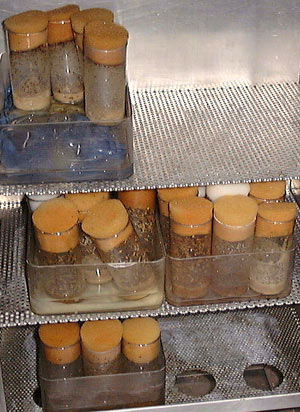
Typical Drosophila vials. Keeping flies over damp paper in a dedicated cabinet helps maintain humidity, and prevents contamination from wild flies.
Why a regime?
Looking after Drosophila is quite easy when you get the hang of it. When cultures crash it's usually because they were left unattended for too long. The life span (just like the development time) is temperature dependent, and does not much exceed 2 weeks as a fly. It is critical to follow a careful regime to allow maximum production. This can take a few minutes each week and that's it. HOWEVER, miss a week and your yield will be drop, miss 2 and you may well loose your cultures! If flies are left too long over old media, they will also starve, and provide a poor snack for the fish. If you can not attend to the flies, its best to keep them cool, slowing down their life cycle (20 deg C) until you can tend to them again.
In general flies should be kept at around 25-28 degrees C. This provides a quick turnover of flies for feeding and allows a weekly regime to be followed. They also like a relatively high humidity; If yours are not kept in a humid room, consider keeping the vials in half a centimeter of water.
So how does the regime work?
The vials that the flies inhabit are separated into 3 categories:
- The present generation of adult flies - laying eggs for future generations (3-4 vials - top shelf of picture)
- Vials containing chrysalised larvae, and newly emerged flies. (10-20 vials - middle shelf of picture)
- Flies or larvae for feeding fish (3-4 vials - bottom shelf of picture).
Once per week newly emerged flies are collected from 2. These are placed in fresh vials, and are designated 1, the present generation. After 3-4 days these flies are moved again, onto new media 3. The old vials (which are loaded with eggs or very young larvae) go back in 2, to make future generations. Once the week has passed, the flies making the present generation can be fed to your fish, and their vials may either go back into 2, or be left for a few days to provide larvae for feeding (see part 5 - feeding fish). Of course a new generation of adult flies is again collected from 2 at the same time.
In hot weather, and if things are going well, you will soon have a lot of flies. On the other hand, you may struggle to breed enough to satisfy your fish. But always avoid feeding newly emerged flies to your fish, even if you have no shortage of flies 'coming through'. Newly collected flies may well be hungry. It's always a good idea to place them over fresh media with added brewers yeast for 24 hours before feeding them to fish, ensuring they are plump and healthy before feeding to your killies.
There are many advantages of keeping to a strict regime such as this:
- Each vial will contain only flies/larvae of approximately the same age, resulting in eclosion (hatching of the adult fly) over a relatively short period. This reduces the time you have to hang onto older vials-making fly collection easier and lessening the chances of mold.
- The longer flies are kept on the same media, the more runny it becomes- if the flies are collected after a 3-4 days, it will still be quite solid. Runny media can drown flies, stick them down and goes everywhere when the jar is inverted.
- All flies will have reached sexual maturity and have reproduced before being fed.
Fruit fly cultures for sale
Killi.co.uk is funded by its visitors. When you buy through links on our site we may earn an affiliate commission. For more info see
terms and conditions.
Dover, Pennsylvania, 173**, UNITED STATES OF AMERICA
$25
Introducing a pack of four fruit fly cultures, specially designed for reptile supplies. These live cultures are brought to you by Crazy Frog Lady L L.C. and are perfect for feeding your pets. You will receive a variety of Turkish Gliders, Golden Hydei, and Flightless fruit flies in this pack.
The high-quality brand ensures that your pets get the best nutrition. These cultures are suitable for pet owners looking for fresh and healthy food for their reptiles. So, if you are looking for a new ...
more
Miami, Florida, 331**, UNITED STATES OF AMERICA
$35
The Nutrifly Fruit Fly Media Culture Mix is a 2 5 lb bag of blended fruit fly cultures designed for use in reptile and pet supplies. This product provides a convenient way to create a nutrient-rich environment for fruit flies, which can be beneficial for pets. The mix is easy to use and helps to support the growth and sustainability of a fruit fly colony for various purposes
This media will last up to 25 cultures...
more
Dover, Pennsylvania, 173**, UNITED STATES OF AMERICA
$30
This package contains four cultures of Turkish Gliders Fruit Fly, perfect for feeding your pet reptiles, including dart frogs. These fruit flies are a delicious and nutritious food source that will keep your pets healthy and happy
Each culture contains a large number of fruit flies, ensuring that you will have enough food for your pets for a while. The package is designed for pet owners who are looking for a high-quality food source for their pets
...
more
Lyndhurst, New Jersey, 070**, UNITED STATES OF AMERICA
$13
Melanogaster Fresh Fruit Fly Cultures and they are an ideal food for Poison Dart Frogs, fish, Praying Mantids, young frogs and toads, and other reptiles, amphibians, or captive animals that require small foods....
more
San Juan, Puerto Rico, 009**, UNITED STATES OF AMERICA
$26
Flightless Fruit Fly Culture (Drosophila Hydei) Reptile Food
LIVE ARRIVAL GUARANTEED!
If you experience any issues, contact us within 1 hour of delivery and include photos of any DOA
Worried About Shipping?
No need! We offer affordable shipping on qualifying orders, and most orders are eligible for our live arrival guarantee. Plus, we include a 10% overcount to compensate for any insects that may be injured during transit
Live...
more



