Pseudoepiplatys annulatus Monrovia
Pseudoepiplatys annulatus Monrovia
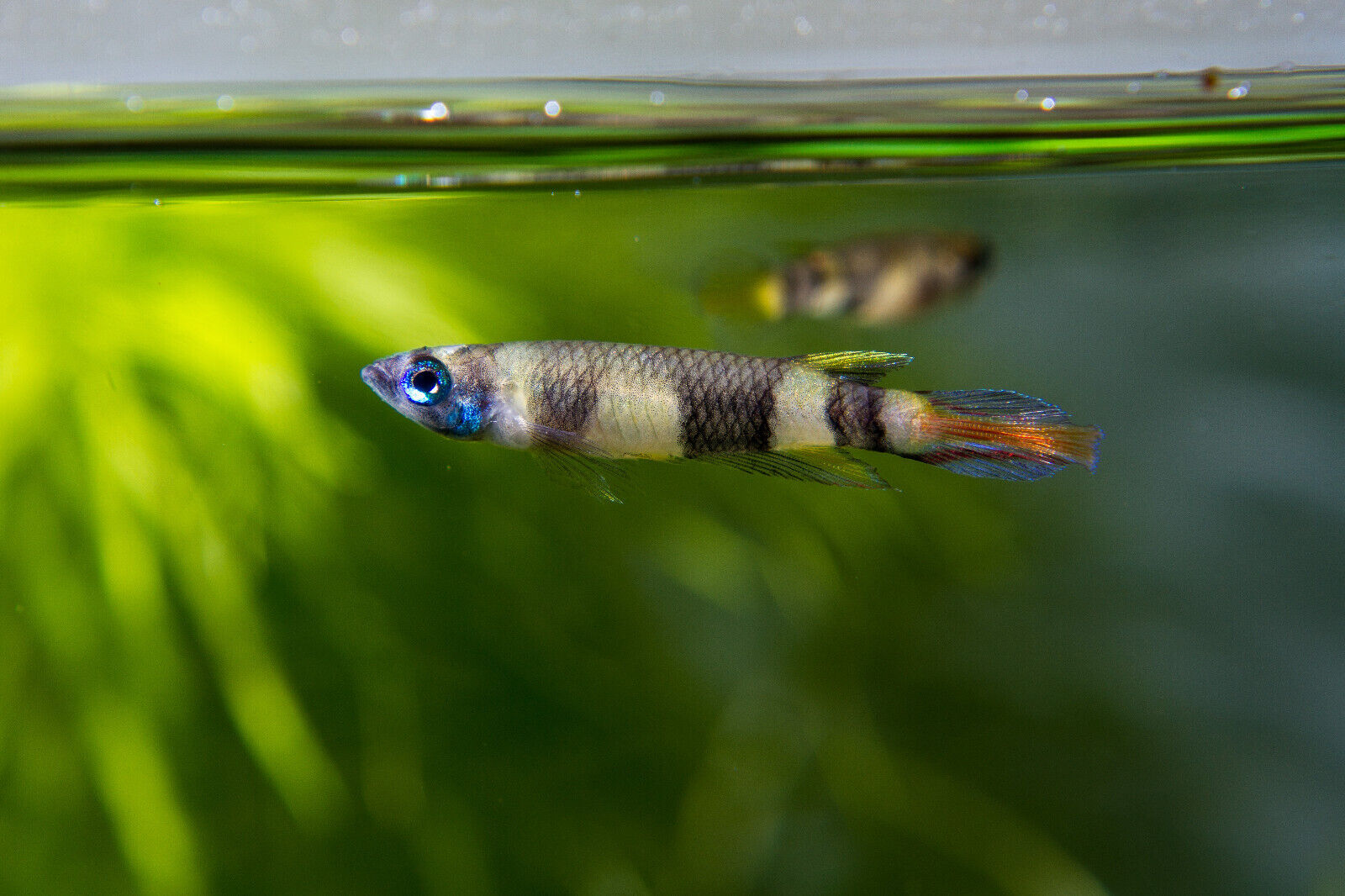
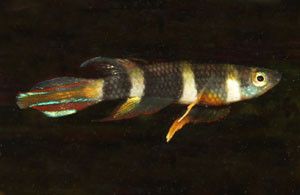
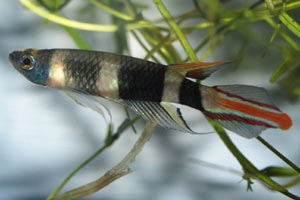
Pseudoepiplatys annulatus . A brightly coloured male.
Current Scientific Name:
Pseudoepiplatys annulatus
Described: (Boulenger), 1915
Common name(s):
Distribution: Liberia, Guinea
Some Recorded Strains:
Kolente
Maboshi
Monrovia
Pseudoepiplatys (or Epiplatys) annulatus is a small delicate killifish that is abundant in the wild, and therefore often available in wild-caught shipments from West Africa. It does best when fed regularly with artemia and other small livefoods; fry will often grow up alongside their parents. Look at this picture of a male annulatus about to eat a fruit fly. Eggs are small and delicate, making picking them from mops less effective than with other species
Breeding Pseudoepiplatys annulatus
Have you had any experience breeding this species? Why not fill in a species questionaire
3 other fishkeepers have successfully bred this species and left reports, their results are sumarised below
Method:
Long term (fry appear with adults) (50%)
Spawning Mops (50%)Water Conditions:
Moderately soft and acidic (100%)Temperature:
24-27°C (50%)
20-23°C (50%)
Read the full breeding report(s) for Pseudoepiplatys annulatus
Killi.co.uk is funded by its visitors. When you buy through links on our site we may earn an affiliate commission. For more info see
terms and conditions.
Lakewood, California, 907**, UNITED STATES OF AMERICA
$9
Welcome to Another Nautilus Tropical Fish Auction!
Introducing the Rocket Killifish ?? A Colorful and Active Nano Fish
The Rocket Killifish (Epiplatys annulatus), also known as the Clown Killifish, is a stunning and peaceful nano fish perfect for small aquariums. With its vibrant red and blue stripes and rocket-like tail pattern, this species is an eye-catching addition to any tank. These surface-dwelling fish are easy to care for and thrive in planted aquariums
FISH ...
more
Indianapolis, Indiana, 462**, UNITED STATES OF AMERICA
$13
* For the safety of our animals, we now ship live fish exclusively via UPS 1 Day Air If your order contains this item, you will only see UPS 1 Day Air as a shipping option during checkout *
This small killifish boasts incredible coloration, especially in males, and is ideal for the nano or planted aquarium!
WE DO NOT GUARANTEE SPECIFIC SEX ON THESE FISH
The Clown Killifish (Epiplatys annulatus) is an extremely colorful, peaceful fish whose small size makes it absolutely ...
more
Bakersfield, California, 933**, UNITED STATES OF AMERICA
$30
Clown Killifish (Epiplatys annulatus) - 4 FISH
WE DO NOT GUARANTEE SPECIFIC SEX ON THESE FISH
READING IS GOOD FOR YOU, SEE BELOW BEFORE BUYING
Do we combine shipping for multiple orders?We combine the shipping if you have multiple orders. Please message us prior to buying so we can figure out what the final shipping cost will be after you purchase. You will charged the shipping initially for each order, but we will go back and make adjustments / refunds for your order via PAYPAL ...
more Pseudoepiplatys annulatus breeding reports
Each record reproduced here represents one instance of breeding this species. Have you kept and bred Pseudoepiplatys annulatus? Why not add a breeding report? If you had different results, or used different methods, please share your experiences
How to keep and breed Pseudoepiplatys annulatus
This database consists of breeding reports provided by the world killifish community, along with some statistical analysis. Results provided by successful keepers are aggregated in the bar charts below, with more detailed reports below that. Like any block of data, the larger the more significant. Please contribute a report of your attempt to breed Pseudoepiplatys annulatus, even if you have had a negative results. You may, of course, file more than one report, particularly if you change some condition, and had a different result.
breeders have filled in breeding reports, a summary of the results are shown in the graphs below.
Would Pseudoepiplatys annulatus be a good addition to a community tank?
- Never
- Doubtful, only with VERY calm fish
- Only with species of similar size
- Yes, a good community fish
How would you describe the disposition of Pseudoepiplatys annulatus?
- Very timid
- Slightly timid
- Neutral
- Somewhat aggressive on occasions
- Very aggressive
In which water conditions do you keep these fish?
- Very soft and acidic
- Moderately soft and acidic
- Neutral
- Moderately hard and alkaline
- Very hard and alkaline
At what average temperature?
- 10-15°C
- 16-19°C
- 20-23°C
- 24-27°C
- 28°C+
What, if any is the biggest difficulty encountered when breeding these fish?
- Poor egg production
- Poor egg survival
- Poor fry survival rate
- Deformities
- Skewed sex ratio
How would you describe sex ratios when breeding Pseudoepiplatys annulatus?
- Almost all males
- Somewhat male heavy
- Roughly equal
- Somewhat female heavy
- Almost all females
In general, how difficult is Pseudoepiplatys annulatus to keep and breed?
- Very easy
- Easy
- Average
- Difficult
- Very difficult
How successful have you been at breeding Pseudoepiplatys annulatus?
- Very unsuccessful
- Fairly unsuccessful
- Average
- Fairly successful
- Very successful
Very successful / fairly successful
Breeding Report: Pseudoepiplatys annulatusLocation code: Maboshi
Water conditions: Moderately soft and acidic, 24-27oC
Spawning Method: Long term (fry appear with adults)
Breeding problems: Poor egg survival
Sex ratio: Somewhat male heavy
Breeding difficulty: Easy
Success: Fairly successful
Other Comments: When fry appear with the adults, I remove them to separate grow-out tanks. Adults do not eat fry but if they are left in the tank the elder siblings will. You will end up with only males as they grow faster than females and eat them before the females have enough time to mature. For this reason, move newborn fry as they appear to grow out tanks and continue to separate the fry by size while they contine to mature.
Mop spawning hasn't worked well for me as the eggs don't seem to tolerate any handling at all.
Breeder: (2 years experience with this species)
Date this record created: 2nd May 2007
Breeding Report: Pseudoepiplatys annulatusLocation code: Monrovia
Water conditions: Moderately soft and acidic, 20-23oC
Spawning Method: Spawning Mops
Breeding problems: Poor fry survival rate
Sex ratio: Roughly equal
Breeding difficulty: Average
Success: Fairly successful
Other Comments: Fry are very canabalistic. It is necessary to separate larger fry several times for an optimal number of survivors.
Otherwise, this fish is quite productive and hardy. In continuous-spawning/permanent setups with adequate floating plants or moss, fry will survive to adulthood, though in much smaller numbers.
Breeder: MWV, Canada (4 years experience with this species)
Date this record created: 19th July 2006
Average success
Breeding Report: Pseudoepiplatys annulatusWater conditions: Moderately soft and acidic, 20-23oC
Spawning Method: Spawning Mops
Breeding problems: Poor fry survival rate
Sex ratio: Somewhat male heavy
Breeding difficulty: Easy
Success: Average
Breeder:
Date this record created: 20th May 2003
Breeding Report: Pseudoepiplatys annulatusWater conditions: Moderately soft and acidic, 24-27oC
Spawning Method: Peat (or similar) spawning substrate
Breeding problems: Poor egg production
Breeding difficulty: Average
Success: Average
Breeder: (1 years experience with this species)
Date this record created: 21st February 2004
Breeding Report: Pseudoepiplatys annulatusLocation code: Monrovia
Water conditions: Moderately soft and acidic, 20-23oC
Spawning Method: Long term (fry appear with adults)
Sex ratio: Roughly equal
Breeding difficulty: Average
Success: Average
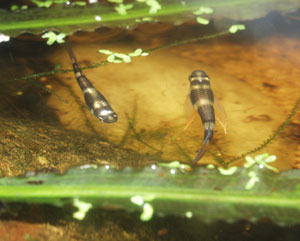
Other Comments: I kept a pair of these in a palludarium (land and water) housing poison dart frogs. This is 6 inches deep, and FULL of drift wood, anubias, bolbitis, etc
Fry appeared with the adults, in small numbers.
I was not trying to breed these at all, and the only food they got was excess fruit flies for the frogs that fell in.
I suspect in a dedicated tank, where fry were removed as the appeared, and artemia was fed I would have many more - As it was they created a small surviving colony that did fine in a very natural surrounding. The pics
here and
here are of these individuals
Breeder: Jules (3 years experience with this species)
Date this record created: 8th December 2004
Breeding Report: Pseudoepiplatys annulatusWater conditions: Very soft and acidic, 20-23oC
Spawning Method: Long term (fry appear with adults)
Breeding problems: Poor egg production
Sex ratio: Roughly equal
Breeding difficulty: Difficult
Success: Average
Breeder: Peter M?čada, Slovakia (1 years experience with this species)
Date this record created: 13th June 2005
Breeding Report: Pseudoepiplatys annulatusLocation code: Monrovia
Water conditions: Moderately soft and acidic, 24-27oC
Spawning Method: Long term (fry appear with adults)
Breeding problems: Poor egg survival
Sex ratio: Roughly equal
Breeding difficulty: Average
Success: Average
Breeder: kho, Singapore (1 years experience with this species)
Date this record created: 7th October 2005
Breeding Report: Pseudoepiplatys annulatusWater conditions: Neutral, 24-27oC
Spawning Method: Long term (fry appear with adults)
Sex ratio: Roughly equal
Breeding difficulty: Average
Success: Average
Breeder: Sweden (1 years experience with this species)
Date this record created: 28th February 2009
Breeding Report: Pseudoepiplatys annulatusWater conditions: Moderately soft and acidic, 24-27oC
Spawning Method: Long term (fry appear with adults)
Sex ratio: Roughly equal
Breeding difficulty: Easy
Success: Average
Other Comments: A few fry appearing in a moderate planted natural tank.
1 male to 7 females.
80L cube tank at 25c.
Shrimp and Ottocinclus also present
Time owned. 3 to 4 months
3 small fry naturally appeared.
Breeder: Uk (1 years experience with this species)
Date this record created: 9th January 2024
Unsuccessful
Breeding Report: Pseudoepiplatys annulatusWater conditions: Moderately soft and acidic, 20-23oC
Breeding difficulty: Average
Success: Fairly unsuccessful
Breeder:
Date this record created: 3rd January 2003
Breeding Report: Pseudoepiplatys annulatusWater conditions: Moderately hard and alkaline
Spawning Method: Spawning Mops
Sex ratio: Roughly equal
Breeding difficulty: Very easy
Success: Very unsuccessful
Breeder: alex krause, allentown, pa 18109 usa (25 years experience with this species)
Date this record created: 29th October 2004
Breeding Report: Pseudoepiplatys annulatusLocation code: Monrovia
Water conditions: Neutral, 28oC+
Spawning Method: Long term (fry appear with adults)
Breeding problems: Poor egg production
Sex ratio: Roughly equal
Breeding difficulty: Easy
Success: Very unsuccessful
Breeder: Kho, Singapore (1 years experience with this species)
Date this record created: 24th October 2005
Breeding Report: Pseudoepiplatys annulatusWater conditions: Moderately soft and acidic, 24-27oC
Spawning Method: Other (see below)
Breeding difficulty: Difficult
Other Comments: I tried these fish (a pair) in a community tank as that was all I had available. They weren't successful and died after a few months. It was heavily planted but they were still very skittish and didn't like the dried food I was giving. Any live food was hoovered up quicker by the other inhabitants. Would probably be OK in a quiet community with small tetras, but mind was a bit too frenetic for them.
No breeding attempt was made.
Breeder: Graham Beek, Chippenham, Wiltshire (1 years experience with this species)
Date this record created: 6th October 2008
Killi.co.uk is funded by its visitors. When you buy through links on our site we may earn an affiliate commission. For more info see
terms and conditions.
Indianapolis, Indiana, 462**, UNITED STATES OF AMERICA
$12
* For the safety of our animals, we now ship live fish exclusively via UPS Next Day Air If your order contains this item, you will only see UPS Next Day Air as a shipping option during checkout *
This small fish is very peaceful and ideal for both beginners and experts alike, plus it is an excellent addition to the planted aquarium!
The Norman??s Lampeye Killifish (Poropanchax normani) is a peaceful fish whose small size makes it absolutely perfect for the nano or planted ...
more
Indianapolis, Indiana, 462**, UNITED STATES OF AMERICA
$66
* For the safety of our animals, we now ship live fish exclusively via UPS Next Day Air If your order contains this item, you will only see UPS Next Day Air as a shipping option during checkout *
The Red Cap Medaka Ricefish is an extremely rare and lovely variant of its species!
The Red Cap Medaka Ricefish (Oryzias latipes ??Red Cap??), also known as the Japanese Ricefish or Japanese Killifish, is an extraordinarily adaptable fish species. This schooling fish can be the ...
more
Indianapolis, Indiana, 462**, UNITED STATES OF AMERICA
$18
* For the safety of our animals, we now ship live fish exclusively via UPS Next Day Air If your order contains this item, you will only see UPS Next Day Air as a shipping option during checkout *
This fairly uncommon lampeye killifish is a real standout due to its iridescent blue-green horizontal striping!
The Neon Stripe Lampeye Killifish (Aplocheilichthys macrophthalmus) is a peaceful fish whose small size makes it absolutely perfect for the nano or planted aquarium. Its ...
more
San Jose, California, 951**, UNITED STATES OF AMERICA
$23
The unisex heavy cotton tee is the basic staple of any wardrobe. It is the foundation upon which casual fashion grows. All it needs is a personalized design to elevate things to profitability. The specialty spun fibers provide a smooth surface for premium printing vividity and sharpness. No side seams mean there are no itchy interruptions under the arms. The shoulders have tape for improved durability.
: 100% Cotton (fiber content may vary for different colors)
: Medium fabric (5 3 ...
more
Indianapolis, Indiana, 462**, UNITED STATES OF AMERICA
$15
* For the safety of our animals, we now ship live fish exclusively via UPS Next Day Air If your order contains this item, you will only see UPS Next Day Air as a shipping option during checkout *
This hardy, robust killifish is an extremely colorful, excellent specimen for the planted aquarium!
The Blue Gardner's Killifish (Fundulopanchax gardneri) is an extremely colorful, peaceful fish whose small size makes it absolutely perfect for the nano or planted aquarium. Native ...
more
Indianapolis, Indiana, 462**, UNITED STATES OF AMERICA
$18
* For the safety of our animals, we now ship live fish exclusively via UPS Next Day Air If your order contains this item, you will only see UPS Next Day Air as a shipping option during checkout *
The American Flagfish, also known as the Florida Flagfish, is a hardy community fish that is one of the few species that eats black beard algae! It is also great for small ponds!
The American Flagfish Killifish (Jordanella floridae) is a colorful, peaceful fish that is native to much of ...
more